How Augmented Reality in Defense is Transforming Military Training & Operations
Modern defense is no longer defined only by firepower and armor. They are shaped by how quickly soldiers can see, understand, and act on information in complex, high-risk environments. This shift is accelerating the adoption of Augmented Reality as a core military capability. Augmented Reality in defense bridges the gap between data and decision-making by layering real-time intelligence directly onto the battlefield.
This article explores how AR is redefining defense operations, beginning with its foundational role, working mechanisms, and core use cases across the defense ecosystem.
What Is Augmented Reality in Defense?
Augmented Reality (AR) in defense refers to the integration of digital information, such as maps, sensor data, and operational cues, into a soldier’s real-world view. While Virtual Reality (VR) immerses users in a completely simulated environment, Augmented Reality overlays digital elements onto the real world, allowing soldiers to remain aware of and interact with their physical surroundings.
In military contexts, AR systems are deployed through military AR headsets, helmet-mounted displays, handheld devices, or vehicle-mounted screens. These systems support AR soldier systems, command centers, and maintenance units across land, air, sea, cyber, and space domains.
Modern AR military technology integrates with GPS, AI, IoT sensors, and battlefield management systems. This enables soldiers and commanders to visualize threats, terrain, and mission-critical data without cognitive overload.
Why AR Matters for Modern Military Operations?
Modern warfare is information-dense and time-sensitive. Soldiers operate in high-risk, complex, and rapidly changing environments where delayed decisions can be fatal. AR addresses this challenge by improving situational awareness, reducing reaction time, and supporting decentralized decision-making. AR situational awareness systems present actionable intelligence directly in a soldier’s line of sight.
Key operational advantages include:
Reduced reliance on handheld maps and radios
Faster orientation in unfamiliar terrain
Improved coordination across dispersed units
As threats become asymmetric and urbanized, Augmented Reality for defense operations provides a decisive cognitive edge.
How AR Works in Defense Environments?
Augmented Reality in defense environments functions by combining real-world visuals with digitally generated information to support soldiers and commanders in real time. It works through the following key components:
Sensing and Data Collection: Sensors such as GPS, cameras, night-vision devices, thermal imagers, drones, and battlefield radars collect real-time environmental and positional data.
Data Processing and Fusion: Advanced computing systems and AI algorithms process and fuse data from multiple sources, including maps, intelligence feeds, and sensor inputs, into a coherent operational picture.
AR Display Systems: Information is displayed through AR-enabled devices such as smart helmets, heads-up displays (HUDs), visors, or tablets, overlaying digital cues directly onto the soldier’s field of view.
Real-Time Overlays: Critical information, such as enemy positions, friendly forces, navigation routes, threat warnings, and mission objectives, is superimposed on the physical environment.
Interaction and Control: Soldiers interact with AR systems via voice commands, gestures, eye tracking, or wearable controls, reducing the need for manual input.
Secure Communication Networks: Encrypted, low-latency military networks ensure real-time data sharing between units, command centers, and allied forces.
By seamlessly merging digital intelligence with real-world perception, AR enhances situational awareness, reduces cognitive load, and enables faster, more accurate decision-making in defense operations.
Key Use Cases of AR in Defense
Augmented Reality is applied across the whole military lifecycle, from training to sustainment and live operations.
Soldier Situational Awareness
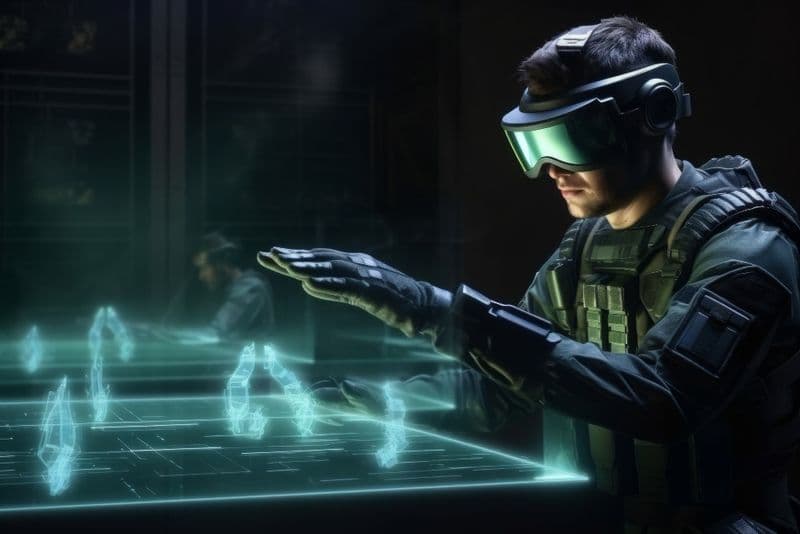
AR overlays threat indicators, terrain data, and friendly positions directly into a soldier’s field of view. This reduces cognitive load and enhances reaction speed. AR soldier systems improve survivability in urban and low-visibility environments.
Combat Training and Simulations
Augmented Reality in military training enables realistic, repeatable exercises without live ammunition. Trainees interact with virtual enemies and scenarios in real environments. The U.S. Marine Corps uses immersive training systems to reduce cost and risk.
Target Identification and Battlefield Visualization
AR battlefield visualization helps soldiers identify targets, avoid friendly fire, and understand line-of-sight constraints. Digital markers enhance accuracy during dynamic engagements.
Navigation and Tactical Mapping
AR navigation for soldiers replaces traditional maps with heads-up route guidance. Terrain elevation, obstacles, and mission checkpoints are visualized in real time, even in GPS-degraded zones.
Maintenance, Repair, and Equipment Guidance
AR provides step-by-step visual instructions for complex repairs. Technicians see overlays directly on equipment, reducing errors and downtime. The U.S. Air Force reports improved maintenance efficiency using AR-guided workflows.
Remote Support and Mission Coordination
AR remote support military systems allow experts to guide field personnel remotely. Live annotations and shared views improve coordination across dispersed units.
Mission Rehearsal and Planning
Commanders use AR to visualize operational plans on physical terrain models. This improves shared understanding before execution.
Medical Support and Combat Casualty Care
AR assists medics with triage guidance and anatomical overlays during emergency treatment, improving response accuracy under stress.
Benefits of AR for Military Forces and Defense Systems
Augmented Reality delivers operational and strategic advantages by enhancing human performance, system efficiency, and mission outcomes across modern defense environments. Let’s look at the key benefits of AR in defense:
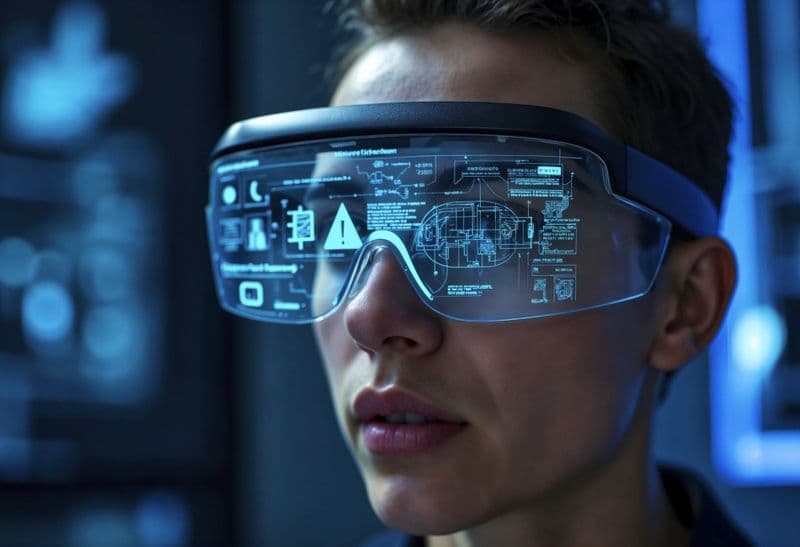
Enhanced situational awareness: AR overlays real-time battlefield data, enabling soldiers to quickly understand threats, terrain, and friendly unit positions.
Faster decision-making: Visual intelligence reduces cognitive processing time, helping commanders and soldiers make accurate decisions under pressure.
Improved mission accuracy: AR-guided targeting and navigation reduce errors, misidentification risks, and friendly-fire incidents during complex operations.
Cost-effective training: Augmented Reality enables realistic training scenarios without live ammunition, lowering operational costs while improving combat readiness.
Reduced equipment downtime: AR-assisted maintenance provides step-by-step visual guidance, minimizing repair errors and accelerating equipment readiness.
Better unit coordination: Shared AR views improve communication and synchronization between dispersed units and command centers during dynamic missions.
Increased soldier safety: Early threat visualization and hazard alerts help soldiers anticipate danger and take protective action in real time.
AR Defense Market Growth and Industry Trends
The Augmented Reality (AR) defense market is experiencing rapid growth as militaries worldwide invest in technologies that enhance situational awareness, operational efficiency, and training effectiveness. Industry analysts project the global military Augmented Reality technologies market will grow at about 17.7 % CAGR from 2024 to 2034, reflecting the increasing integration of digital overlays, sensor fusion, and real-time data visualization across defense operations.
Market growth is driven by:
Rising defense budgets for immersive technologies, particularly across the U.S. Army, Air Force, and Marine Corps modernization initiatives
Increased demand for Augmented Reality in military training, enabling scalable, low-risk, and cost-efficient combat readiness programs
Advancements in military AR headsets and optics, improving durability, field-of-view, and usability in extreme operational environments
Growing focus on multi-domain operations and data-driven warfare, where AR battlefield visualization enhances speed, coordination, and decision superiority
AR for Military Training, Simulation, and Skill Development
Training remains one of the most impactful applications of AR. Augmented Reality in military training integrates physical environments with digital threats, enabling realistic, adaptive exercises.
Unlike traditional simulations, AR allows soldiers to train in actual terrain while interacting with virtual enemies and mission variables. This improves muscle memory, spatial awareness, and stress conditioning.
Key advantages of AR combat simulation include:
Repeatable scenarios with variable difficulty
Safe training for high-risk missions
Rapid skill development for recruits
These immersive military training systems prepare forces for real-world complexity without the cost of live exercises.
AR for Real-Time Operations, Battlefield Awareness, and Decision Support
In live operations, AR functions as a real-time decision-support layer. Augmented Reality for defense operations connects soldiers, vehicles, and command centers through shared visual intelligence.
AR battlefield visualization enables commanders to see unit positions, threat vectors, and terrain constraints in real time. This shared operational picture improves coordination and reduces miscommunication.
For dismounted soldiers, AR soldier systems provide:
Heads-up alerts
Threat prioritization cues
Live navigation assistance
By reducing cognitive friction, AR enhances both individual and collective decision-making under pressure.
App-Less AR: Improving Field Accessibility and Deployment Speed
Traditional AR systems often rely on pre-installed applications, which limit flexibility in field environments. App-less AR for defense addresses this challenge by enabling instant access through secure web-based or device-native interfaces.
This approach improves:
Deployment speed during missions
Accessibility across mixed hardware environments
Security through centralized control
App-less AR reduces logistical overhead and supports rapid updates without physical device retrieval. This is particularly valuable for distributed units operating in austere conditions.
Real-World Examples and Defense Use Cases of AR
Several military organizations have already operationalized AR military technology across training and field environments. Key real-world examples and defense use cases include:
U.S. Army - Integrated Visual Augmentation System (IVAS): The U.S. Army uses IVAS to provide soldiers with real-time navigation, threat detection, and situational awareness through advanced military AR headsets.
U.S. Air Force - Aircraft maintenance and inspections: AR-guided maintenance systems overlay digital instructions on aircraft components, reducing human error and significantly improving maintenance turnaround time.
U.S. Marine Corps - Immersive combat training: The Marine Corps applies Augmented Reality in military training to simulate urban combat, live-fire coordination, and decision-making under realistic conditions.
NATO forces - Mission rehearsal and joint operations: NATO members use AR battlefield visualization to rehearse missions and improve interoperability across multinational units during joint exercises.
Naval forces - Ship maintenance and damage control: AR supports sailors with visual repair guidance and system diagnostics, improving response speed during equipment failures at sea.
Medical and combat casualty care units: AR assists medics with triage protocols and anatomical overlays, improving accuracy during high-stress battlefield medical interventions.
Implementation Framework for Defense Organisations
A structured implementation framework ensures Augmented Reality delivers operational value while aligning with security, scalability, and mission-readiness requirements in defense organizations. Key stages of an effective AR implementation framework include:
Operational needs assessment: Identify mission gaps where Augmented Reality can improve situational awareness, training efficiency, or maintenance accuracy.
Pilot programs and controlled trials: Deploy AR in limited units to validate performance, usability, and operational impact before large-scale rollout.
Hardware and device selection: Choose mission-appropriate devices, including military AR headsets or handheld systems, based on environment and durability needs.
Secure systems integration: Integrate AR platforms with existing command, control, and intelligence systems while meeting defense cybersecurity standards.
Training and change management: Prepare personnel through hands-on training to ensure rapid adoption and minimal resistance across defense units.
Scalability and lifecycle planning: Design for long-term deployment, updates, and expansion across multiple units, missions, and environments.
Key Metrics to Measure AR Impact in Defense
Quantifying impact is essential for sustained funding and leadership support. Defense organizations track both operational and human-performance metrics.
Key metrics used to measure AR impact in defense include:
Decision-making speed: Reduction in time taken by soldiers and commanders to interpret information and execute operational decisions.
Mission success rate: Improvement in mission outcomes, accuracy, and objective completion after integrating AR-enabled systems.
Situational awareness improvement: Measured increase in threat detection, terrain understanding, and friendly-force visibility using AR soldier systems.
Training efficiency and cost reduction: Decrease in training time, resource consumption, and overall cost through Augmented Reality in military training programs.
Maintenance accuracy and downtime: Reduction in repair errors and equipment downtime using AR-guided maintenance and technical support.
User adoption and usability: Engagement levels, ease of use, and sustained utilization of AR tools across defense personnel and operational units.
Challenges in Adopting AR for Defense & How to Overcome Them
Despite its operational advantages, adopting Augmented Reality in defense presents technical, organizational, and environmental challenges that must be addressed strategically.
Key challenges and mitigation approaches include:
Hardware durability in combat environments: AR devices must withstand extreme weather, impact, and vibration; ruggedized, military-grade hardware standards help address this risk.
Cybersecurity and data integrity concerns: AR systems process sensitive data, requiring encrypted communications, zero-trust architectures, and continuous security monitoring.
Integration with legacy defense systems: Older platforms may lack compatibility; open architectures and modular integration frameworks reduce interoperability barriers.
User fatigue and ergonomic limitations: Prolonged AR use can cause discomfort; human-centered design and lightweight military AR headsets improve usability.
Connectivity limitations in contested zones: Reliance on networks can hinder deployment; offline-capable and edge-computing-based AR systems ensure operational continuity.
Change management and adoption resistance: Personnel may resist new tools; phased deployment, training, and demonstrated operational benefits drive acceptance.
Future of AR in Defense, Warfare, and Military Innovation
The future of AR in defense lies in convergence with artificial intelligence, autonomous systems, and edge computing. AR will increasingly function as the primary interface between humans and machines.
Future developments include:
AI-driven threat prioritization
Predictive logistics and maintenance
Fully integrated AR soldier systems
Joint human–autonomous mission execution
As warfare becomes faster and more data-centric, AR will define how soldiers perceive and act on the battlefield.
Conclusion
Augmented Reality in defense is reshaping how military forces train, operate, and sustain combat readiness. By enhancing perception, reducing cognitive load, and accelerating decision-making, AR delivers measurable operational advantages.
With scalable platforms, app-less deployment models, and proven field use cases, AR is no longer experimental. It is becoming foundational to modern defense systems and the future of military innovation.
Transform static ads into immersive experiences. Use Flam’s AI-native format to engage audiences instantly, boost interaction, and make your brand impossible to ignore.
Comments
Your comment has been submitted