How Augmented Reality in Interior Design is Reinventing Space Designing
A client walks into a design studio, unsure whether the sleek, modern sofa they love will actually fit their living room. Instead of flipping through 2D renderings, the interior designer hands them a tablet. Within seconds, the client sees their exact space on screen, with the chosen sofa, lighting, and color scheme. They walk around the room, rotate the furniture, and even change the fabric in real time. The hesitation fades; the decision becomes instant.
That's the power of Augmented Reality in interior design, a technology that merges creativity with precision. This article explores the application of AR technology in interior design, its benefits, real-world applications, and challenges.
What Is Augmented Reality in Interior Design?
Augmented Reality (AR) in interior design refers to the integration of digital 3D models, textures, and spatial data into real-world environments using devices such as smartphones, tablets, or AR glasses. Unlike Virtual Reality, which creates a fully simulated environment, AR enhances the real world by layering interactive elements onto it.
In the design process, AR enables professionals to visualize changes in real-time, helping clients see how new furniture fits, how color palettes interact with lighting, or how spatial adjustments affect functionality. This reduces uncertainty and speeds up the decision-making process.
How Augmented Reality Works in Interior Design?
AR in interior design relies on a combination of hardware, software, and real-time data processing. Here's a simplified breakdown of how it works:
Spatial Mapping: AR software utilizes a device's camera to scan the environment, detecting surfaces, dimensions, and depth. This step builds a 3D spatial map of the physical area.
3D Visualization: Once the space is mapped, designers import digital assets, such as 3D furniture models, color schemes, or lighting options, into the environment. These assets are aligned with real-world surfaces to simulate placement and proportion.
Rendering and Interaction: The AR engine renders objects in real time, allowing users to rotate, resize, or reposition them. Some advanced tools even simulate natural lighting, shadows, and reflections for accurate visualization.
Client Collaboration: AR applications enable clients to interact with the design virtually, allowing them to explore and refine their ideas. They can walk through their redesigned space using AR glasses or mobile apps, providing feedback instantly.
Example: Platforms like IKEA Place or Houzz's View in My Room allow users to preview furniture and décor in their actual space before buying. These AR-driven tools reduce costly design errors and improve client engagement.
Key Benefits of Augmented Reality in Interior Design
The benefits of Augmented Reality in interior design extend beyond visualization to include operational efficiency, marketing, and enhanced client experience.
1. Enhanced Visualization and Accuracy
Traditional 2D drawings or renderings often fail to convey spatial relationships. AR solves this by allowing real-scale visualization, improving design accuracy, and minimizing revisions.
2. Better Client Engagement
Clients often struggle to interpret design concepts. AR technology in interior design provides an intuitive and interactive experience that bridges the communication gap between designers and clients. When clients can "walk through" a design before it's built, satisfaction rates rise significantly.
3. Reduced Costs and Errors
AR enables quick prototyping and eliminates guesswork. By identifying spatial or aesthetic conflicts early, firms can avoid costly mistakes during the implementation process.
4. Streamlined Collaboration
interior design projects involve multiple stakeholders, including architects, contractors, suppliers, and project managers. AR platforms enable teams to collaborate remotely, visualize updates in real-time, and maintain a consistent design intent.
5. Marketing and Sales Enablement
AR is a powerful sales tool. Furniture and décor brands use AR-based 3D visualization in interior design to showcase products in context, thereby enhancing buyer confidence and reducing product returns.
Applications and Use Cases of AR in Interior Design
Augmented Reality is reshaping the interior design industry from concept to completion. Below are the most impactful uses of Augmented Reality in interior design that are redefining professional workflows across the sector.
1. Space Planning and Layout Visualization
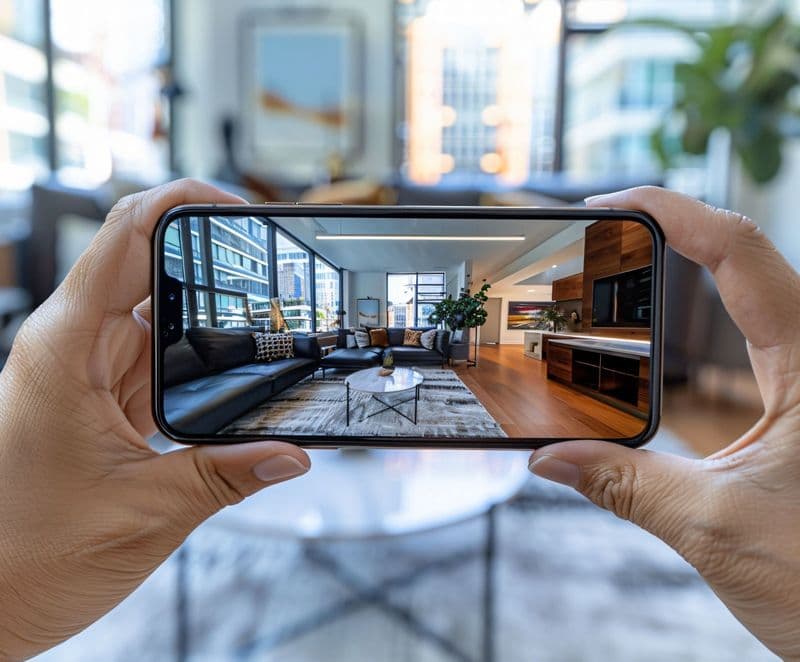
AR enables designers to map and test room layouts with real-world accuracy. By scanning a space, professionals can virtually position walls, furniture, and lighting fixtures to confirm flow and proportion before any construction or purchase. This minimizes rework and material waste.
2. Client Presentation and Virtual Staging
Design presentations have shifted from static boards to interactive experiences. AR tools allow clients to view designs directly in their own spaces through smartphones or tablets. In real estate and hospitality, virtual staging with AR enables buyers and stakeholders to visualize furnished spaces, leading to higher project approval rates and shorter sales cycles.
3. Product Customization and Specification
Manufacturers and furniture vendors utilize AR technology in interior design to enable clients to configure products, adjusting color, material, or dimensions in real-time. This reduces uncertainty in bulk orders and enhances transparency in procurement and supply chain coordination.
4. On-Site Design Validation
Design teams use AR applications on-site to overlay digital blueprints over physical structures. This helps verify alignment between planned and executed work, identify discrepancies early, and improve collaboration among architects, contractors, and project managers.
5. Marketing and Client Acquisition
AR-driven product visualization enhances marketing presentations and showrooms. Furniture retailers and design firms use AR catalogs to demonstrate how products fit within various spaces, thereby improving engagement and conversion rates.
6. Training and Skill Development
Design schools and firms use AR for professional training. Trainees interact with full-scale 3D models to understand spatial planning, lighting behavior, and material performance, improving design accuracy and efficiency.
7. Collaboration Across Teams and Stakeholders
Large-scale commercial projects require coordination between multiple professionals. AR supports remote collaboration by allowing all stakeholders to visualize design progress and provide feedback in shared virtual environments.
Real-World Examples of AR in Interior Design
Several interior design organizations have already integrated AR technology in interior design to improve accuracy, user experience, and collaboration. Below are some notable examples:
1. IKEA Place
One of the most recognized AR applications, IKEA Place, enables users to visualize furniture in real-world spaces using their smartphone camera. Customers can see how a sofa or table fits within their room's dimensions before making a purchase. This has not only enhanced user confidence but also reduced product return rates.
2. Houzz "View in My Room 3D"
Houzz, a major home design platform, offers an AR feature that allows users to place 3D models of décor items directly in their homes. This functionality supports designers and vendors by enhancing client visualization and enabling consumers to make informed purchasing decisions.
3. Morpholio Board and AR SketchWalk
Morpholio, a professional design app, has developed AR SketchWalk, which allows architects and interior designers to walk through 3D scaled models in Augmented Reality. This tool enhances spatial understanding, offering clients a first-hand look at design concepts before construction begins.
4. Home Depot Project Color
Home Depot's AR paint visualization tool enables users to test wall colors in real-world environments. The app takes into account lighting and wall texture, enabling both homeowners and professional designers to achieve precise color matching.
5. Modsy
Modsy combines Augmented Reality with AI to offer personalized room designs. Users upload images of their spaces, and Modsy creates detailed 3D renderings that can be edited and visualized using AR. Interior design firms use Modsy's technology to showcase concept variations and help clients visualize different furniture arrangements and décor styles in real-world environments.
6. DecorMatters
DecorMatters is an AR-powered design app that enables real-time collaboration among designers, brands, and clients. Users can create and share interactive design boards, visualize furniture in their own rooms, and collaborate with peers. For interior design teams, this platform supports remote work, concept validation, and digital client onboarding while delivering a visually engaging experience.
Challenges of Augmented Reality in Interior Design
Despite its rapid adoption, AR in interior design faces several technical and operational challenges that can limit its scalability and accuracy.
Cost barrier: Deploying AR platforms requires investment in specialized software, high-performance devices, and skilled professionals. For small and mid-sized design firms, these upfront costs can limit scalability and long-term adoption.
Technical Skill and Training Gaps: Effective use of AR tools demands digital proficiency and 3D modeling knowledge. Many design teams still lack technical training, creating a barrier to fully integrating AR into daily workflows.
Data Accuracy and Calibration Issues: AR visualization relies on precise spatial mapping. Poor lighting, incorrect scaling, or surface recognition errors can distort designs, reducing trust and accuracy during client presentations or construction planning.
Hardware Compatibility Limitations: Not all clients or contractors use AR-enabled devices. This restricts real-time collaboration and can lead to inconsistent design visualization across different platforms or hardware systems.
Integration with Existing Design Software: AR tools often operate separately from CAD or BIM platforms. Lack of seamless data exchange complicates workflows, requiring designers to duplicate efforts or manually convert project files.
Privacy and Data Security Concerns: AR applications capture real spatial and image data. Without secure storage protocols, sensitive project or client information could be at risk, raising compliance and confidentiality issues.
Managing Client Expectations: Ultra-realistic AR renderings can set expectations that exceed practical or budgetary constraints. Designers must balance the impact of visualization with transparent communication about feasibility and cost.
The Future of Augmented Reality in Interior Design
The future of Augmented Reality in interior design looks promising, with innovations in artificial intelligence, machine learning, and IoT integration driving the next wave of transformation.
1. AI-Driven Personalization
Future AR systems will use AI to analyze client preferences and automatically suggest design layouts, furniture arrangements, and materials. This could shorten project timelines and improve design precision.
2. Integration with Smart Homes and IoT
AR will soon link directly to smart home ecosystems, allowing users to visualize connected lighting, HVAC systems, and furniture configurations that adapt to real-time data from sensors.
3. Mixed Reality and Immersive Collaboration
Combining AR, VR, and MR will let design teams work in hybrid environments, overlaying digital plans over physical construction sites. This could revolutionize project management and stakeholder communication.
4. Sustainable Design Optimization
AR tools will increasingly simulate environmental conditions, such as daylight exposure and thermal behavior, helping designers make sustainable decisions aligned with green building standards like LEED and WELL.
5. Expansion into Industrial and Commercial Design
Beyond residential spaces, AR is being adopted in corporate, retail, and hospitality design to create interactive design presentations and real-time space planning models.
Smarter Interior Designing with Augmented Reality
Augmented Reality in interior design is reshaping how professionals conceptualize, present, and deliver spaces. By merging digital precision with real-world context, AR empowers design firms to make faster decisions, minimize errors, and elevate client experiences through immersive visualization.
As technology advances, AR will become a cornerstone of modern design strategy, bridging creativity with data, collaboration, and sustainability. For design firms, embracing AR isn't just a technological upgrade; it's a strategic move toward innovation, efficiency, and long-term growth in a rapidly evolving industry.
Reimagine Advertising with Flam's Immersive Technology. Step beyond static ads and create interactive, story-driven brand experiences that connect, convert, and stay remembered. Partner with Flam today and lead the next wave of AR-powered marketing.
Comments
Your comment has been submitted