How Extended Reality in Manufacturing Enables Immersive Design and Innovation
Extended Reality (XR) is rapidly reshaping manufacturing by bringing immersive, interactive technology directly into factory workflows. Instead of relying on manuals, trial-and-error training, or costly physical prototypes, workers and engineers can now visualize machinery in 3D, rehearse tasks in safe simulations, and access real-time digital guidance on the floor.
This shift is revolutionizing safety training, simplifying complex assembly and maintenance, and significantly reducing operational costs. The introduction of XR in manufacturing has helped teams work faster, make fewer mistakes, and create smarter, safer, and more efficient industrial environments.
What Is Extended Reality (XR) in Manufacturing?
Extended Reality (XR) in manufacturing refers to the use of immersive technologies such as Augmented Reality (AR), Virtual Reality (VR), and Mixed Reality (MR) to enhance real-world industrial processes. AR vs VR vs MR in manufacturing blends digital visuals, instructions, and simulations with physical factory environments to help workers interact with complex machines, workflows, and data more intuitively.
In practice, this can mean using VR for safe, hands-on training; AR for step-by-step guidance during assembly or maintenance; or MR for visualizing prototypes and layouts at full scale. Together, these tools streamline operations, improve accuracy, and support smarter decision-making across the entire manufacturing lifecycle.
Components of XR: AR, VR, and MR in the Manufacturing Context
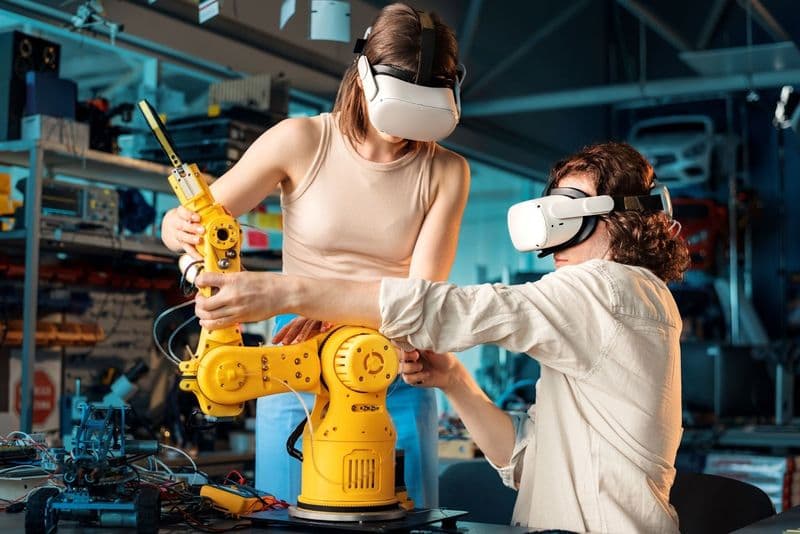
Extended Reality in the manufacturing sector is built on three core technologies.
Augmented Reality (AR) overlays digital instructions, 3D models, or alerts onto real machinery, helping workers complete tasks faster and more accurately.
Virtual Reality (VR) creates fully immersive training and simulation environments where employees can practice hazardous or complex procedures without risk.
Mixed Reality (MR) blends both worlds, allowing users to interact with digital objects anchored to real equipment. It is ideal for prototyping, layout planning, and remote expert assistance.
Why XR Matters in the Manufacturing Sector Today
XR can resolve the most pressing issues facing the world of manufacturing today. Issues related to productivity, minimizing errors, and lack of skilled workers. XR directly addresses all three.
With aging workforces, rising product complexity, and global competition, immersive tools help teams learn faster, collaborate remotely, and solve problems on the spot.
XR reduces training costs, prevents safety incidents, shortens maintenance time, and accelerates product development through virtual prototyping. In today’s fast-moving industrial landscape, XR isn’t just an upgrade; it’s a critical enabler of modern, resilient, and highly efficient manufacturing.
How XR Works in Factory Environments and Industrial Workflows
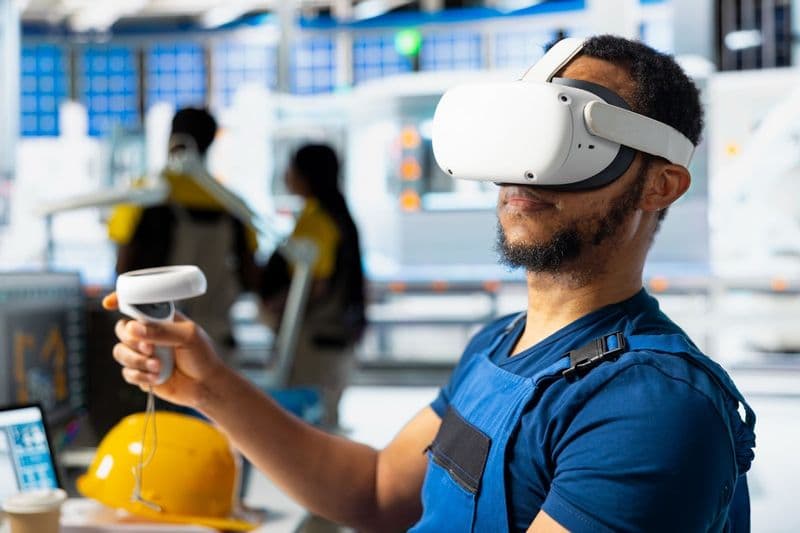
XR integrates digital information directly into the daily operations of factories, guiding workers, speeding up decision-making, and reducing errors. In practice, XR tools use sensors, cameras, and spatial tracking to map real-world environments, then overlay virtual elements such as instructions, 3D models, alerts, or simulations onto machinery or workstations.
Key Use Cases of XR in Manufacturing
XR is transforming factory operations by blending digital intelligence with real-world tasks. Here are some examples of extended reality in the manufacturing industry:
Assembly & Maintenance Guidance (AR): Workers wearing AR glasses or using tablets can see step-by-step instructions overlaid on equipment. For example, use of extended reality in the automotive industry is common. Automotive plants use AR to guide technicians through wiring, component installation, or diagnostics. This helps reduce training time and minimizes mistakes.
Safety Training (VR): VR simulations allow employees to practice navigating high-risk environments like chemical plants or welding stations without real-world danger. Factories use VR to train workers on emergency responses, machine handling, and hazard recognition.
Remote Assistance (MR): With MR headsets like HoloLens, a technician on the factory floor can share their view with an off-site expert, who can then draw virtual markers or highlight components in real time. This reduces downtime and avoids travel delays.
Virtual Prototyping and Layout Planning (MR/VR): Engineers can visualize full-scale machinery, test production line layouts, or review design changes virtually before anything is built. This helps identify bottlenecks early and saves on physical prototyping costs.
Quality Inspection (AR): AR overlays allow inspectors to compare a finished part against a digital twin, detecting deviations instantly. Some electronics manufacturers use this to speed up PCB or component-level inspections.
Product Design, Prototyping & Digital Twins (VR/MR): Engineers can walk around full-scale virtual prototypes, test functionality, and refine designs before manufacturing begins. Digital twins help teams monitor line performance, predict failures, and optimize layouts.
Benefits of XR for Manufacturers, Operators, and Technicians
Faster Training & Onboarding: With VR simulations, workers can practice complex or hazardous tasks in a safe virtual environment, building confidence before working on real machines.
Reduced Costs and Errors: Virtual prototyping reduces the need for physical prototypes; AR-guided assembly and maintenance reduce mistakes and rework.
Improved Safety and Risk Mitigation: XR lets employees train for dangerous operations or emergency protocols without exposure to real hazards.
Higher Productivity and Consistency: AR overlays provide clear, step-by-step instructions on the shop floor, ensuring uniform quality across operators.
Enhanced Collaboration and Flexibility: Remote teams can review designs or support maintenance via shared virtual environments, enabling faster decision-making and less downtime.
XR Market Growth and Adoption Trends in Manufacturing
According to a report by Virtue Market Research, the global market for XR in manufacturing was valued at USD 14.47 billion in 2022 and is projected to rise to USD 39.29 billion by 2030, growing at a CAGR of about 13.3% between 2023 and 2030.
The growth is driven by increasing demand for immersive training, remote assistance, real-time maintenance support, and efficiencies in production, which makes XR tools (AR/VR/MR) attractive across industries.
As hardware (headsets, sensors) becomes more affordable and XR-software easier to deploy, adoption is expanding from large manufacturers to mid-sized factories as well. This signals XR’s shift from pilot projects to mainstream deployment in manufacturing workflows.
XR for Workforce Training and Skill Development
One of the greatest XR manufacturing solutions is the development of XR-based training modules. These modules allow workers to repeatedly practice complex or hazardous processes in a controlled virtual environment. This leads to better retention, quicker skill acquisition, and safer training outcomes.
Since XR training does not require shutting down production or risking equipment, it lowers downtime and training costs while ensuring that workers gain confidence before working on real machines.
As manufacturing increasingly demands multi-skilled workers capable of handling complex tasks and safety protocols, XR becomes a critical tool for ongoing upskilling and consistent workforce readiness.
App-Less XR: Reducing Friction for Industrial Deployment
One of the key barriers to XR adoption has been the need for heavy, custom software installations or specialized apps. But modern XR solutions, especially those using browser-based delivery or cloud-enabled WebXR/AR, let manufacturers deploy immersive guidance, training, or remote assistance with minimal friction.
This “app-less” approach means:
Faster rollout across multiple facilities without any heavy installs or device locking.
Easier adoption for technicians/operators and allows anyone with a compatible device to access XR content.
Lower barriers for small and mid-sized manufacturers to make XR accessible even without large IT infrastructure or investments.
Real-World Examples and Industry Case Studies
1. Lockheed Martin Employs VR for Spacecraft Assembly Training
Lockheed Martin leverages VR for spacecraft assembly and astronaut training. Teams can interact with virtual spacecraft components, improving accuracy in assembly and ensuring flawless execution in high-stakes operations.
2. General Electric (GE) Using AR for Worker Training
Another example of the use of Augmented Reality in manufacturing is GE's use of AR-based training programs for its turbine and aviation divisions. Trainees receive interactive, step-by-step digital instructions over real equipment, cutting training time by 30% while boosting confidence and performance consistency.
3. Airbus's AR for Quality Assurance
Airbus uses AR for aircraft cabin and structural inspections, allowing workers to compare real assemblies with 3D digital models. The approach increases accuracy, accelerates inspections, and enhances compliance documentation in aircraft production lines.
4. Siemens' AR-Driven Equipment Maintenance
Siemens applies AR in predictive maintenance, allowing technicians to visualize sensor data directly on equipment. This proactive approach reduces downtime and supports faster, safer repairs across industrial plants.
5. Boeing's AR-Enhanced Wiring Assembly
Boeing implemented AR to assist in the assembly of complex aircraft wiring harnesses. By overlaying digital 3D instructions through AR glasses, technicians reduced assembly time by 25% and error rates by over 40%.
6. Honeywell: Industrial Workforce Development
Honeywell's Immersive Field Simulator trains industrial workers in realistic plant scenarios. The platform uses VR to replicate control rooms and field environments, enhancing safety awareness and reducing human error.
Implementation Framework for Manufacturing Teams and Leaders
A practical XR rollout begins by identifying the problem areas, such as training gaps, assembly errors, or maintenance delays, and selecting an XR tool that addresses them without adding operational complexity. Here is how the ideal XR integration process looks like theoretically:
Identify the problems: Determine the issues, such as skill gaps, maintenance delays, or inefficient workflows.
Introduce AR tools and software: Once the problem is earmarked, you can connect your AR tools with software for training, upskilling, remote expert assistance, data access, and much more.
Constant Monitoring: To measure success, conduct continuous analytics on performance, safety, and efficiency to ensure long-term ROI.
Key Metrics for Measuring XR Impact in Manufacturing
Manufacturers evaluate XR by tracking improvements in both operational efficiency and workforce performance. Common KPIs include:
Tracking Training Time Reduction with the help of VR modules.
Error and Rework Rates during assembly or maintenance tasks.
First-time-Fix Rates when technicians use AR for guided repairs.
Downtime Reduction from MR-enabled remote support.
Inspection Speed and Accuracy using AR overlays or digital twins.
Cost Savings from fewer prototypes, safer training, and shorter troubleshooting cycles.
Worker Adoption and Task Completion Rates, measuring ease of use and actual workflow impact.
Challenges in XR Adoption & How to Address Them
High Upfront Hardware Costs: Start with mobile-based or app-less XR to reduce investment.
Resistance to New Technology: Provide hands-on demos and integrate XR into existing workflows gradually.
Content Creation Bottlenecks: Use low-code platforms that let teams build AR/VR modules without specialized developers.
Integration with Legacy Systems: Choose XR tools that support APIs and digital twins for seamless data exchange.
Safety and Ergonomics Concerns: Pilot test devices on the shop floor and refine headset usage based on feedback.
Future of XR-Driven Smart Factories and Industry 5.0
As XR converges with AI, IoT, and robotics, factories will increasingly rely on immersive interfaces to monitor equipment, run predictive maintenance, and manage entire lines from a mixed-reality dashboard.
Digital twins will become fully interactive, allowing engineers to manipulate live factory data in 3D, while workers receive intelligent AR guidance tailored to their skill level. In the future, XR won’t just support workflows; it will be the control panel of the smart, autonomous factory.
Conclusion
Extended Reality is rapidly becoming a core enabler of modern manufacturing, transforming how teams train, assemble, inspect, and collaborate. By simplifying complex tasks, improving safety, and cutting operational costs, XR is moving from experimental pilots to everyday industrial tools.
As devices become lighter, content creation gets easier, and app-less deployment removes friction, XR will play a defining role in shaping smarter, safer, and more efficient factories around the world.
Comments
Your comment has been submitted