A Deep Dive into the Use of Augmented Reality in Corporate Training
Corporate learning is under pressure as evolving job roles demand faster, more flexible, and more accurate skill development. Traditional methods, such as manuals, videos, and classroom sessions, struggle to keep pace with real-time workplace needs. Employees require training formats that match how they work: digitally, visually, and interactively.
This article explains how Augmented Reality in corporate training bridges that gap. It explores what AR is, how it outperforms traditional learning, key applications, benefits, challenges, and the future of AR-driven workforce development.
What Is Augmented Reality in Corporate Training?
Augmented Reality (AR) in corporate training refers to the use of interactive digital overlays, such as 3D models, instructions, animations, or real-time guidance, superimposed onto the physical world through devices like smartphones, tablets, or AR headsets. Instead of learning from static manuals or traditional e-learning modules, employees can engage with training content right in their real work environment.
AR blends digital information with the user’s surroundings, making training more intuitive, hands-on, and context-driven. A technician can see step-by-step instructions mapped onto actual machinery, a sales associate can practice customer interactions using AR-driven scenarios, and new hires can explore virtual walkthroughs of facilities before ever stepping onto the floor.
Why AR Outperforms Traditional Training Methods?
Traditional corporate training methods often struggle to keep today’s learners fully engaged. The static formats used in traditional training lack interaction and rarely provide the immersive practice needed to build real confidence. They can also be expensive to deliver at scale and fall short in offering real-time, contextual support during actual tasks. As a result, employees may complete training without feeling truly prepared for on-the-job challenges.
AR transforms learning by making training more engaging, interactive, and immersive, allowing employees to learn by doing rather than just listening. It enables safe, hands-on simulations where learners can practice repeatedly without any operational risks. With adaptive and personalized learning paths, AR tailors guidance to each employee’s pace and skill level. Combined with on-demand, contextual overlays and reduced training costs, AR delivers a powerful upgrade to corporate learning.
AR Applications in Corporate Training
AR supports multiple training formats suited for different functions and industries. The most common applications include:
1. Equipment Operation and Maintenance Training
Technical teams learn faster when they can visualize components and receive step-by-step overlays on equipment. AR provides interactive 3D instructions to guide workers through calibration, maintenance, repair, and quality checks.
This reduces reliance on paper manuals and supports safer operations. Manufacturing, aviation, logistics, and energy sectors often use Augmented Reality training solutions to standardize complex procedures across multiple sites.
2. Safety and Hazard Simulation
AR creates controlled environments where employees practice responses to hazardous situations without exposure to actual danger. These simulations help companies meet OSHA-aligned safety goals by reinforcing safe behavior.
Common use cases include:
Chemical spill response
Fire evacuation routes
Electrical hazard identification
Machine-zone safety protocols
This makes AR safety training one of the most impactful use cases in corporate settings.
3. Onboarding and Orientation
New employees often struggle to understand processes and physical layouts. AR supports onboarding with spatial guidance, virtual facility tours, and interactive role previews.
Through AR onboarding training, new hires explore their workspace using mobile-based markers or WebAR experiences. This reduces information overload and accelerates time-to-productivity.
4. Product Knowledge and Sales Training
Product teams and sales representatives must learn complex specifications quickly. AR enables them to view 3D models, animations, and exploded views of products, even when physical samples are unavailable.
Industries such as automotive, electronics, medtech, and industrial equipment rely on AR product training to boost customer readiness and sales performance.
5. Soft Skills and Leadership Development
AR supports behavioral training by simulating real-world interactions with AI-driven virtual characters. These characters provide cues, react to tone, and adapt to user decisions.
Use cases include:
Customer service
Negotiation and conflict resolution
Leadership and coaching conversations
Diversity and inclusion scenarios
6. Remote Expert Collaboration
Field employees can stream their view to remote experts who annotate instructions in Augmented Reality. This reduces downtime and improves troubleshooting accuracy.
Industries with distributed teams, such as telecom, utilities, and field services, benefit from AR-powered collaboration, especially in environments with limited access to senior technicians.
7. Compliance and Process Training
Regulated industries require consistent compliance training across locations. AR reinforces compliance by providing visual cues, digital checklists, and guided inspections.
Examples include:
FDA-regulated environments
ISO compliance procedures
SOP walk-throughs for pharmaceutical or biotech teams
Quality assessments in manufacturing
By making compliance training practical, AR helps organizations reduce audit risks and procedural errors.
8. Workflow Automation and Just-In-Time Training
Instead of learning everything up front, employees receive contextual guidance exactly when needed. AR helps reduce cognitive load by delivering micro-instructions at the point of action.
This “learn-as-you-work” model supports:
Warehousing and inventory tasks
Assembly-line operations
Service-based troubleshooting
Quality assurance processes
Companies implementing Augmented Reality in workplace environments achieve a significant reduction in task errors and onboarding time.
Key Benefits of AR for Workforce Development
Augmented Reality employee training delivers enterprise-level benefits rooted in performance improvement and cost efficiency. Let’s look at some of the most impactful benefits AR brings to modern training programs:
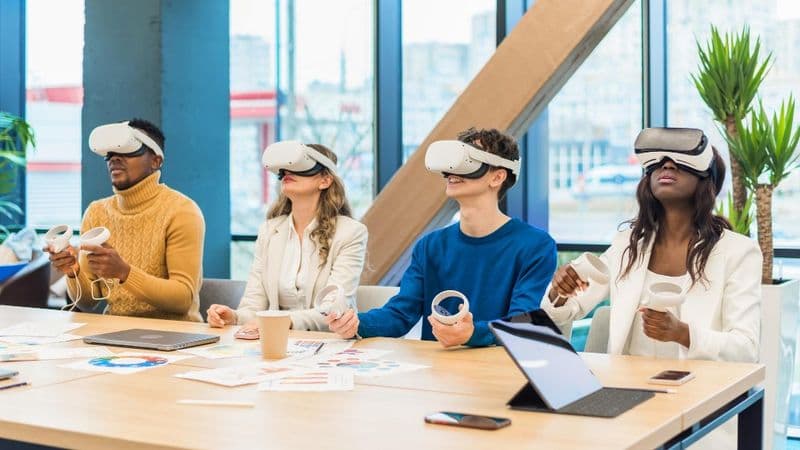
Accelerates Skill Development: AR delivers immersive, hands-on guidance that helps employees learn complex tasks faster, reducing training time while improving practical understanding and retention.
Boosts Engagement and Motivation: Interactive AR modules transform passive learning into dynamic experiences that maintain employee interest and significantly increase overall participation in training programs.
Provides Risk-Free Practice Environments: Employees can safely simulate hazardous or high-stakes scenarios using AR, gaining confidence and competence without exposure to real-world dangers or costly mistakes.
Ensures Consistent Global Training Quality: Standardized AR content enables organizations to deliver identical, high-quality training across all locations, reducing skill disparities and improving operational reliability worldwide.
Delivers Real-Time Feedback and Guidance: AR overlays provide immediate corrective instructions during tasks, helping employees learn independently while minimizing errors and reinforcing best practices continuously.
Lowers Long-Term Training Costs: By reducing reliance on physical materials, travel, and equipment prototypes, AR significantly cuts training expenses while increasing scalability and training efficiency.
Improves Knowledge Retention and Recall: AR blends visual and interactive elements with contextual practice, helping employees retain information longer and apply skills more accurately in real-world situations.
Enhances Remote Collaboration and Support: AR enables specialists to guide field workers virtually through live annotations, strengthening teamwork, speeding problem resolution, and expanding access to expert knowledge.
By leveraging the benefits of Augmented Reality training, companies strengthen workforce capability while maintaining operational efficiency.
AR for Onboarding and Skill Acceleration
Traditional onboarding often overwhelms new hires with dense information. AR improves this by providing interactive, digestible learning that adapts to the employee’s pace.
Key Use Cases:
Facility tours using AR markers
Step-by-step workstation setup
Real-time role training using task simulations
Interactive tutorials for standard operating procedures
AR onboarding training supports faster ramp-up, better confidence, and reduced dependency on supervisors. It is especially valuable for teams working in hybrid or remote environments, where hands-on onboarding traditionally requires on-site presence.
AR for Technical, Safety, and Equipment Training
Technical roles require accuracy, precision, and repetition, areas where AR excels.
Examples:
Maintenance and repair tasks with 3D-guided instructions
Safety drills using hazard simulations without exposing employees to danger
Equipment operation training through interactive overlays
Compliance training following OSHA guidelines
In industries such as manufacturing, energy, aviation, and logistics, AR safety training and equipment-based learning reduce downtime and improve workplace readiness.
AR for Soft Skills and Behavioral Training
Soft skills are harder to teach because traditional formats rely on observation rather than real interaction. AR soft skills training creates immersive scenarios in which employees practice communication, conflict resolution, customer service, and leadership behaviors.
Digital characters powered by AI respond to tone, gestures, and word choices. Employees receive real-time feedback and repeat scenarios until proficiency improves.
Common use cases include:
Customer service simulations
Sales pitch practice with virtual stakeholders
Conflict management and negotiation drills
Leadership coaching scenarios
AR makes soft skill development measurable, repeatable, and scalable across distributed teams.
App-Less AR: Reducing Friction in Training Deployment
One of the biggest barriers to adoption is the requirement to download apps or configure devices. App-less AR, often powered by WebAR, removes this friction by enabling employees to access Augmented Reality for training through a browser.
This approach reduces IT dependencies and accelerates rollout in large enterprises. It also supports bring-your-own-device (BYOD) training environments, making AR accessible across mobile platforms.
Benefits for corporate teams include:
Faster deployment across locations
Minimal device configuration
Lower user resistance and higher completion rates
Immediate scalability for thousands of employees
App-less AR enables companies to experiment with immersive learning without investing in heavy infrastructure.
Metrics to Measure AR Training Effectiveness
A structured measurement framework ensures AR contributes to business outcomes. Companies typically track the following metrics:
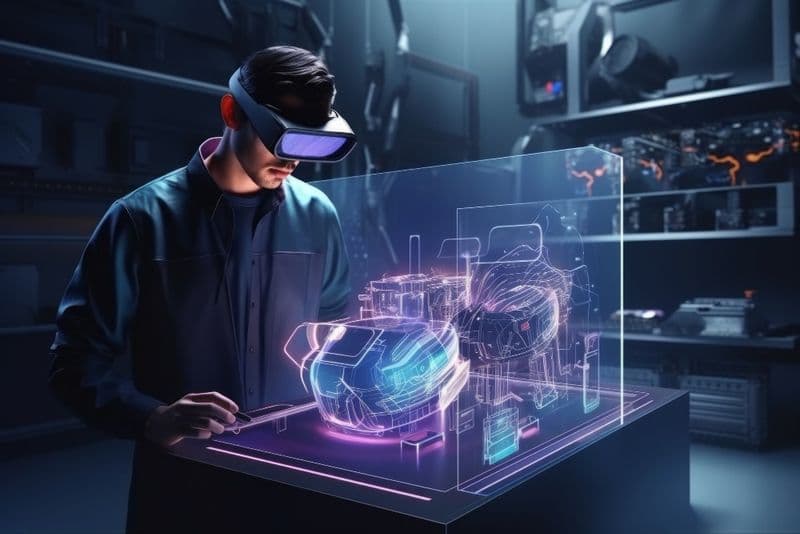
1. Task Completion Time
This measures how quickly employees can perform a task after completing an AR module. Shorter completion times indicate better understanding and higher confidence. Companies use this metric to compare pre- and post-training performance and identify workflows where AR produces the most improvement.
2. Error Reduction and Safety Compliance
A key advantage of AR is its ability to reduce mistakes by guiding employees through precise, step-by-step instructions. Organizations track reductions in errors, rework, and safety incidents.
3. Knowledge Retention Scores
AR modules often include embedded quizzes, visual prompts, or scenario-based assessments. These components allow trainers to measure retention over time, not just immediately after training. High retention demonstrates that Augmented Reality employee training supports long-term skill development.
4. Module Completion and Engagement Rates
Engagement analytics reveal how employees interact with AR content. Metrics typically include:
Completion percentage
Time spent per module
Number of attempts per task
Drop-off points within the experience
Higher engagement signifies that AR is resonating with employees and replacing passive learning with active participation.
5. First-Time Right Performance
This measures how often employees complete a task correctly on their first attempt after AR training. It is especially valuable for technical, manufacturing, and safety-critical environments. Consistent first-time accuracy indicates effective knowledge transfer and reduced dependency on supervisors.
6. Real-Time Performance Feedback
Modern AR platforms record how employees follow instructions, where they hesitate, and how long they take for each step. Training teams use this data to identify skill gaps at the individual and team level. This supports continuous improvement and strengthens the value of Augmented Reality training solutions.
7. Productivity and Throughput Gains
Organizations compare employee performance before and after deploying AR. Metrics include:
Output per hour
Downtime reduction
Time saved on routine tasks
These improvements demonstrate AR’s direct impact on operational efficiency and business outcomes.
8. Training Cost Reduction
Companies track savings achieved by replacing physical equipment, instructor-led sessions, or travel with AR-based training. This financial metric helps justify long-term investment and scaling of Augmented Reality for training.
9. User Satisfaction and Training Experience Scores
Employee feedback through surveys, post-module evaluations, and net promoter scores (NPS) provides insight into how effective and user-friendly AR training feels. High satisfaction often correlates with sustained adoption and reduced resistance to new training technologies.
Common Challenges in AR Training & How to Overcome Them
AR offers measurable value, but organizations must address operational and cultural barriers to adoption.
1. High Initial Implementation Costs
Challenge: Developing custom AR content, purchasing devices, and integrating systems can be expensive for organizations starting out.
How to Overcome: Begin with small pilot projects, leverage reusable AR templates, and use employee-owned devices where possible to reduce hardware costs and validate ROI before scaling.
2. Technical Compatibility & Infrastructure Limitations
Challenge: AR applications may require strong connectivity, updated hardware, and integration with existing LMS platforms.
How to Overcome: Conduct a technical readiness assessment, invest in scalable cloud-based AR platforms, and ensure IT teams are involved early to avoid compatibility issues.
3. Resistance to New Technology
Challenge: Some employees may feel hesitant or intimidated when learning through AR, especially if they are unfamiliar with advanced digital tools.
How to Overcome: Introduce AR gradually, provide hands-on demos, offer simple onboarding tutorials, and highlight how AR reduces workload and improves understanding.
4. Content Development Complexity
Challenge: Creating high-quality AR training experiences can be time-consuming and may require specialized skills in 3D modeling or simulation.
How to Overcome: Use low-code or no-code AR authoring tools, partner with AR content specialists, and repurpose existing 3D assets to streamline content creation.
5. Limited Scalability Across Departments
Challenge: AR solutions designed for one team or location may not easily scale to others due to varying workflows or equipment.
How to Overcome: Design modular AR training content, standardize processes where possible, and choose platforms that support multi-device deployment across roles and facilities.
6. User Discomfort or Device Limitations
Challenge: Heavy headsets, limited battery life, or discomfort during long sessions can affect user experience.
How to Overcome: Choose ergonomically designed AR devices, offer shorter session durations, and prioritize mobile-based AR for more accessible, lighter interactions.
7. Measuring Impact and ROI
Challenge: Organizations often struggle to quantify the effectiveness of AR training beyond engagement metrics.
How to Overcome: Define clear KPIs early, such as error reduction, time-to-competency, and performance improvements, and integrate analytics tools to gather actionable insights.
Addressing these barriers helps organizations roll out Augmented Reality employee training at scale.
Future of AR-Driven Corporate Learning
The future of corporate learning will rely heavily on real-time, context-aware, AI-personalized training. AR will serve as the bridge between traditional e-learning and hands-on instruction.
Key trends include:
AI-generated AR modules tailored to job roles
Smart glasses integration for frontline workers
Enterprise-level adoption of AR micro-learning
Greater reliance on app-less AR for mass deployment
Data-driven personalization using behavioral analytics
These innovations demonstrate the expanding role and future of corporate training with AR, supporting a workforce that learns continuously and performs with greater precision.
Final Thoughts
Augmented Reality in corporate training is transforming how organizations build skilled, confident, and productive teams. By merging digital instructions with real environments, AR removes barriers that slow down traditional training. It accelerates onboarding, supports technical and safety training, enhances soft skills, and ensures consistency across global locations.
As app-less AR and AI-first platforms simplify deployment, the technology is becoming accessible to companies of all sizes. The organizations that adopt AR early will lead in productivity, innovation, and workforce readiness.
Reinvent customer engagement with Flam’s Mixed Reality advertising platform. Launch App-less immersive advertising experiences in seconds. Capture attention, deepen storytelling, and accelerate brand impact.
Comments
Your comment has been submitted